Through the Lens of Milan: Where Culture Clicks
Ever walked through a city that feels like a living museum? Milan isn’t just fashion and trains—it’s golden cathedrals, quiet courtyards, and espresso moments caught in golden light. As a photographer, I didn’t just visit—I saw. Every alley told a story, every shadow held history. This is more than travel; it’s about capturing soul through the lens. And Milan? It gives you everything—if you know where to look. With its seamless blend of Renaissance grandeur and modern vitality, the city offers a visual narrative that unfolds slowly, rewarding those who pause to observe. This journey is not measured in miles, but in moments framed by light, gesture, and memory.
First Impressions: Beyond the Fashion Facade
Milan is often introduced as Italy’s cosmopolitan heart, a city celebrated for its runways, luxury boutiques, and sleek metro lines. Yet beneath this polished surface lies a deeply rooted cultural identity shaped by centuries of artistry, craftsmanship, and quiet ritual. For travelers arriving with preconceptions of a purely modern metropolis, the first surprise is how tactile and layered the city feels. The air carries the scent of fresh bread from neighborhood panetterie, the distant chime of church bells, and the soft rustle of pages turned in sunlit piazzas. These sensory details form the true essence of Milan, far removed from glossy magazine spreads.
Photographically, the initial encounter with Milan presents a compelling contrast: glass skyscrapers rise beside 18th-century palazzos, while vintage trams glide past minimalist storefronts. This duality offers rich opportunities for composition—juxtaposing old and new, texture and reflection, stillness and motion. The Galleria Vittorio Emanuele II, for instance, is more than a shopping arcade; it is a cathedral of commerce, its iron-and-glass dome filtering light like stained glass. Early morning visits reveal the space nearly empty, allowing for clean lines and long exposures that emphasize symmetry and depth.
To truly absorb Milan’s spirit, one must resist the urge to rush. Slowing down allows the camera—and the observer—to notice subtleties: the pattern of cobblestones worn smooth by centuries of footsteps, the way sunlight strikes a weathered fresco at 10:15 a.m., or the quiet dignity of an elderly woman arranging flowers outside her doorway. These are not staged scenes but lived moments, the quiet pulse of a city that values both elegance and authenticity. By approaching Milan not as a checklist of landmarks but as a living, breathing entity, photographers open themselves to deeper, more meaningful captures.
Arrival at Milan’s central station, Centrale, sets the tone. Though grand and imposing, the station is also a crossroads of daily life—commuters, travelers, and street musicians pass beneath its vaulted ceilings. A wide-angle lens can capture the scale of the architecture, while a tighter frame on a single face in the crowd reveals individual stories. This balance between the monumental and the personal defines successful cultural photography in Milan. It is not enough to document what is famous; one must seek what is felt.
The Duomo Diaries: Light, Lace, and Long Exposures
No visit to Milan is complete without standing before the Duomo, a masterpiece of Gothic architecture that has dominated the city’s skyline for over six centuries. More than 3,000 statues adorn its façade, and 135 spires reach toward the heavens like stone flames. To photograph the Duomo is to engage with one of the most complex surfaces in European architecture—a lacework of marble carved with such precision that even in shadow, detail emerges. But capturing its essence requires more than a wide shot from the square; it demands patience, timing, and an understanding of light as a storytelling tool.
The cathedral’s exterior transforms dramatically throughout the day. At sunrise, the eastern façade glows with a soft amber hue, highlighting the intricate carvings without harsh contrast. This is the ideal time for long exposures that smooth the movement of early visitors into ghostly blurs, emphasizing the building’s permanence. By midday, direct sunlight flattens textures, but reflections in rain puddles on the piazza offer creative alternatives—upside-down versions of the Duomo, fractured and poetic. Late afternoon brings the golden hour, when the western side of the cathedral catches warm, directional light, casting long shadows that accentuate depth and dimension.
For a more immersive perspective, climbing to the rooftop terraces is essential. Accessible by elevator or stairs, the upper level places the photographer among the spires, offering eye-level views of saints and gargoyles. From here, wide-angle shots can capture the forest of stone pinnacles against the sky, while macro lenses reveal the weathering of centuries—cracks in marble, lichen growth, and the delicate tracery of decorative elements. The experience is not merely visual; the wind whistles between the spires, and the city sprawls below like a living map.
Interior photography presents unique challenges. The vast nave, dimly lit by stained glass, requires higher ISO settings or tripods (where permitted). The play of colored light on stone floors creates natural compositions, especially during midday when sunlight streams through the rose window. Capturing the spiritual atmosphere means focusing not only on architecture but on human presence—kneeling figures, flickering votive candles, or a shaft of light falling across an empty pew. These moments convey reverence, not through grand gestures but through stillness.
Equally important is ethical awareness. The Duomo remains an active place of worship, and photographers must balance artistic intent with respect. Avoiding intrusive zooms, refraining from flash near prayer areas, and being mindful of personal space ensure that documentation does not disrupt devotion. When done with care, Duomo photography becomes more than a record of beauty—it becomes a meditation on time, faith, and human aspiration.
Hidden Courtyards and Silent Alleys: Offbeat Milan
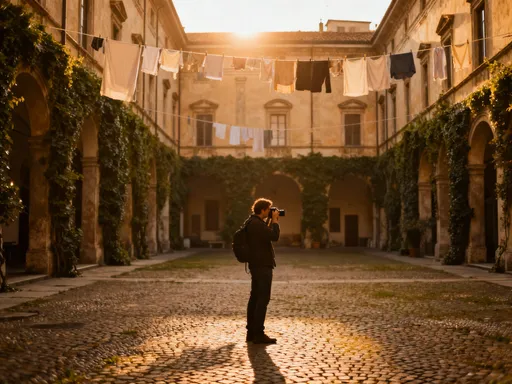
Beyond the postcard-perfect piazzas, Milan’s soul resides in its hidden courtyards—cortili—quiet enclosures tucked behind unassuming doorways in Renaissance and Baroque palaces. These spaces, once the private domains of noble families, are now shared by residents, artists, and the occasional curious visitor. They offer some of the most intimate photographic opportunities in the city: ivy climbing weathered brick, laundry strung between windows, cats napping on sun-warmed steps, and the occasional glimpse of a musician practicing behind a half-open shutter.
The Brera district, known for its art academy and bohemian charm, is home to several such courtyards. One particularly photogenic example lies behind Palazzo Citterio, where a central well is surrounded by arches and potted plants. Early morning light filters through the courtyard’s canopy, creating dappled patterns on the stone. Because these spaces are residential, access is often limited, but many are open during daylight hours. The key is to move quietly, observe without intrusion, and seek permission when photographing individuals. A warm smile and a nod can go further than a lens cap.
Another hidden gem is the courtyard of Santa Maria delle Grazie, the church housing Leonardo da Vinci’s The Last Supper. While the refectory itself is strictly controlled, the surrounding cloister offers serene compositions—arched walkways, geometric paving, and the soft green of ivy against pale stone. Photographers can capture the rhythm of repetition in the arches, using leading lines to draw the eye toward a single figure walking in contemplation. The atmosphere here is one of stillness, a rare quality in an urban setting.
Other cortili can be found in the area around Via dei Giardini and in the historic district of Porta Ticinese, where converted warehouses now house design studios and small galleries. These spaces often feature industrial remnants—exposed beams, rusted pipes, vintage signage—juxtaposed with modern life. A photograph of a bicycle leaning against a centuries-old wall, or a coffee cup on a windowsill overlooking a vine-covered courtyard, speaks to the continuity of daily existence.
Street photography in these zones thrives on authenticity. Rather than staging scenes, the goal is to document life as it unfolds. This requires patience and discretion. Using a quieter mirrorless camera, avoiding direct eye contact when appropriate, and shooting in burst mode to capture fleeting expressions can yield powerful results. Ethical framing means respecting privacy—blurring faces when necessary, avoiding shots of children without consent, and never exploiting vulnerability for aesthetic gain. The most compelling images from Milan’s hidden corners are those that honor the dignity of their subjects.
Art in Motion: Capturing La Scala and Local Performances
Culture in Milan is not confined to static monuments; it pulses through music, dance, and performance. Nowhere is this more evident than at Teatro alla Scala, one of the world’s most revered opera houses. While interior photography is strictly prohibited during performances, the building itself offers rich visual material. The neoclassical façade, crowned with statues of musical muses, is best photographed at dusk, when warm interior lighting contrasts with the cooling sky. Reflections in the polished stone of the piazza create symmetrical compositions, doubling the grandeur of the structure.
Nearby, the Scala Museum displays historic costumes, instruments, and set designs—many of which can be photographed under low-light conditions. These artifacts tell the story of Italian opera through texture and color: brocade gowns, gold-leaf masks, and handwritten scores. A macro lens can capture the embroidery on a 19th-century tenor’s jacket, while a wider shot might frame a mannequin against a backdrop of crimson velvet. These images, though static, evoke movement—the imagined sweep of a curtain, the rise of a soprano’s voice.
For dynamic photography, public performances in the city’s parks and squares provide ideal opportunities. The gardens of Sforza Castle often host open-air concerts, where musicians play under the trees for small audiences. These moments are ripe for capturing motion: a violinist’s bow blurring in mid-air, a cellist’s focused expression, or sunlight catching the curve of a brass instrument. Using shutter speeds between 1/30 and 1/60 of a second introduces intentional motion blur, emphasizing rhythm and energy.
Street performers near the Galleria or along Via Dante add another layer to Milan’s cultural tapestry. A saxophonist playing jazz under an archway, a mime frozen in silent drama, or a dancer rehearsing steps on cobblestones—all offer compelling subjects. The challenge lies in balancing environmental context with subject focus. A wide aperture can isolate the performer from a busy background, while a deeper depth of field situates them within the urban landscape. Capturing audience reactions—children clapping, an elderly couple swaying—adds emotional depth.
Lighting plays a crucial role. Natural light works well during daytime performances, but evening scenes require careful exposure. The warm glow of streetlamps or café signs can enhance mood, but urban light pollution may necessitate higher ISO settings. Noise reduction in post-processing should be applied subtly to preserve grain and atmosphere. Ultimately, photographing performance in Milan is about conveying emotion—not just the act of playing music, but the feeling it evokes in those who listen.
Food as Culture: Framing the Flavors of Milan
In Milan, cuisine is heritage. Dishes like risotto alla milanese, flavored with saffron brought by monks centuries ago, or panettone, whose origins trace back to a Christmas legend, are more than meals—they are edible history. To photograph food in Milan is to document tradition in motion: hands kneading dough, steam rising from simmering pots, elders passing recipes to younger generations. These moments, rich in texture and emotion, offer some of the most authentic storytelling opportunities in cultural photography.
Family-run trattorias in neighborhoods like Navigli or Magenta provide ideal settings. Unlike staged restaurant photography, the goal here is to capture the process—the nonna folding ravioli with practiced fingers, the butcher selecting cuts for ossobuco, the baker pulling golden loaves from a wood-fired oven. Natural light, especially in morning hours, enhances warmth and authenticity. Shooting near a window, using diffused light, avoids harsh shadows and preserves the natural color of ingredients.
Composition benefits from including traditional elements: ceramic plates, linen napkins, copper pots. A close-up of saffron threads dissolving into broth, shot with a shallow depth of field, can become a powerful symbol of patience and care. Including hands in the frame—wrinkled, flour-dusted, or young and eager—adds humanity. These are not anonymous cooks but custodians of culture.
Markets like Mercato Centrale in the former slaughterhouse of Lambrate offer vibrant scenes of abundance. Stalls overflow with seasonal produce—white asparagus in spring, porcini mushrooms in autumn, blood oranges in winter. Vendors arrange their goods with pride, creating natural still lifes. A wide-angle lens can capture the energy of the market, while a telephoto isolates details: a scale balancing figs, a knife slicing mortadella, a child reaching for a peach. Building rapport is essential; a few words in Italian, a smile, or a small purchase can open doors to more intimate shots.
Photographing aperitivo hour—when locals gather for drinks and small plates in outdoor cafes—adds social context. The clink of glasses, laughter, and the rustle of newspaper pages create a rhythm that can be felt through the lens. Using a fast prime lens allows for sharp focus in low light, freezing moments of connection. These images, though seemingly casual, preserve the rituals that bind communities together.
The Photographic Rhythm: Timing, Seasons, and Light Cycles
Successful cultural photography in Milan depends on understanding the city’s natural and urban rhythms. Light changes not only with the time of day but with the season, weather, and even air quality. Winter brings soft, diffused light that wraps around buildings, ideal for capturing the Duomo’s façade without harsh contrast. Fog along the Navigli canals creates moody, atmospheric scenes, transforming ordinary bridges into silhouettes emerging from mist.
Spring introduces pastel blossoms—cherry, magnolia, and wisteria—that frame historic buildings in delicate color. Sempione Park becomes a canvas of green and bloom, where couples stroll and children fly kites. Early morning during this season offers golden light filtered through new leaves, perfect for portraits and environmental shots. Summer brings long days and vibrant evening activity. Aperitivo scenes in Brera or Isola districts pulse with color and movement, best captured with a higher shutter speed to freeze motion or a slower one to blur passing figures, suggesting energy.
Fall is perhaps the most photogenic season. The golden tones of late afternoon light enhance the city’s warm stone architecture, and fallen leaves add texture to cobblestone streets. The interior of churches and museums benefits from this light, as it penetrates stained glass with greater intensity. Photographers should use apps like PhotoPills or Sun Surveyor to track sunrise, sunset, and golden hour windows, planning shoots accordingly.
Weather variability requires adaptable gear. A lightweight rain cover protects equipment during sudden showers, while a polarizing filter can reduce glare on wet surfaces. Urban light pollution affects night photography, but Milan’s historic centers often have warmer, less harsh lighting than other cities. Long exposures of illuminated facades, especially during blue hour, yield striking results. The key is consistency—returning to the same location at different times to see how light transforms it.
From Click to Meaning: Why These Images Matter
A photograph from Milan is more than a memory; it is a testament to presence. In an age of rapid travel and digital saturation, the act of slowing down to frame a moment—of noticing how light falls on a saint’s face, how hands shape dough, how silence echoes in a courtyard—becomes an act of reverence. These images do not merely document; they connect. They bridge time, culture, and personal experience, preserving the intangible: dignity, tradition, quiet joy.
For the photographer, the goal is not perfection but truth. It is found in the wrinkle of a baker’s apron, the reflection of a spire in a rain puddle, the fleeting glance of a passerby caught in golden light. These are not just compositions—they are conversations with the city. Each click is a choice to see deeply, to honor what is real over what is staged.
Ultimately, Milan teaches that culture is not something to be consumed but to be lived. Through the lens, we do not take from the city—we listen. And in return, it reveals itself, one frame at a time. The photographs we bring home are not souvenirs; they are invitations—to remember, to reflect, to return. In capturing Milan, we do not merely record a place. We learn to see the world—and ourselves—more clearly.